Every day we are being asked what is better for our district? on-prem solution or cloud base.
The purpose of this article is to highlight the main differences between a cloud-based solution and an
onpremises solution for the CCTV system currently being implemented at a school district.
A sample budget for a school is also included to illustrate how overall costs are impacted when
comparing cloud and onpremises deployments.
The systems we used to compare the two are open platform not a proprietary system which is a crucial
factor that allows the school to replace the video management system in the future and still use the
existing cameras with a different management system.
This comparison addresses the following topics:
- Warranty, Management & Maintenance
- Cost Model
- Architecture, Scalability & MultiSite
- Summary & Recommendation
- Budget (example)
Warranty, Management & Maintenance
On Premises:
The school’s IT team is responsible for daytoday system management, including:
Applying OS and VMS software patches and updates
Monitoring storage health and capacity
Replacing failed disks and/or NVRs
Cameras include a 5year warranty.
Cybersecurity (hardening, patching, network security) is the responsibility of the district’s IT
department.
Cloud:
The manufacturer manages software updates, system scaling, and core infrastructure as part of
the annual subscription.
A centralized web console provides multisite visibility and management.
There is a reduced burden on internal IT staff, but greater operational dependence on the
vendor.
Cameras include a 10year warranty.
Cost Model
On Premises
Higher upfront capital expenditure (CapEx) for:
NVRs/servers, storage, UPS, racks, and licenses
Extending storage retention may require server and storage upgrades.
Lower ongoing software fees, but continuing costs for:
Hardware refresh every 4–7 years
Maintenance, updates, and internal IT labor
Cloud
Lower upfront costs due to reduced onsite server and storage requirements.
Ongoing subscription (OpEx) on a percamera or persite basis.
Storage retention (e.g., 30/60/90 days) can be increased or decreased by adjusting
subscriptions, without additional hardware costs.
Architecture, Scalability & MultiSite
On Premises CCTV
NVRs/VMS servers are located on site (MDF/IDF or security room).
Video is stored primarily on local hard drives.
Remote access typically relies on VPN or secure portforwarding.
Adding more schools requires deploying and maintaining additional servers.
Cloud CCTV
Cameras send video to a cloud service (sometimes via a small local gateway or recorder).
Video is stored in the vendor’s data centers, with optional local backup if desired.
Remote access is provided via secure web portals or mobile apps over the internet.
The system is designed to scale: adding cameras or sites involves assigning additional licenses;
the platform scales automatically.
Which Approach Does SOC Recommend?
On Premises would be recommended if:
Internet connectivity was limited or unreliable (this is not the case at our school district;
connectivity is strong).
Policy or regulation required that all video be stored locally.
The district had extensive IT/security staff capacity dedicated to managing servers, storage, and
cybersecurity.
For the school district, a cloud solution is likely the preferred option because:
The district has good, reliable internet and sufficient upstream bandwidth.
Cloud provides simpler, centralized remote and multisite management.
Internal IT resources are limited and already responsible for many other systems; reducing the
need to maintain security servers and storage is a significant benefit.
The manufacturer will continue to update the cloud platform and introduce new features
without requiring hardware refreshes by the district or additional costs.
The extended camera warranty and reduced infrastructure burden mean that, over time, the
school district is likely to spend less on maintenance and replacement compared to a fully
onpremises solution.
No need to replace any of the existing cameras already installed at the existing projects
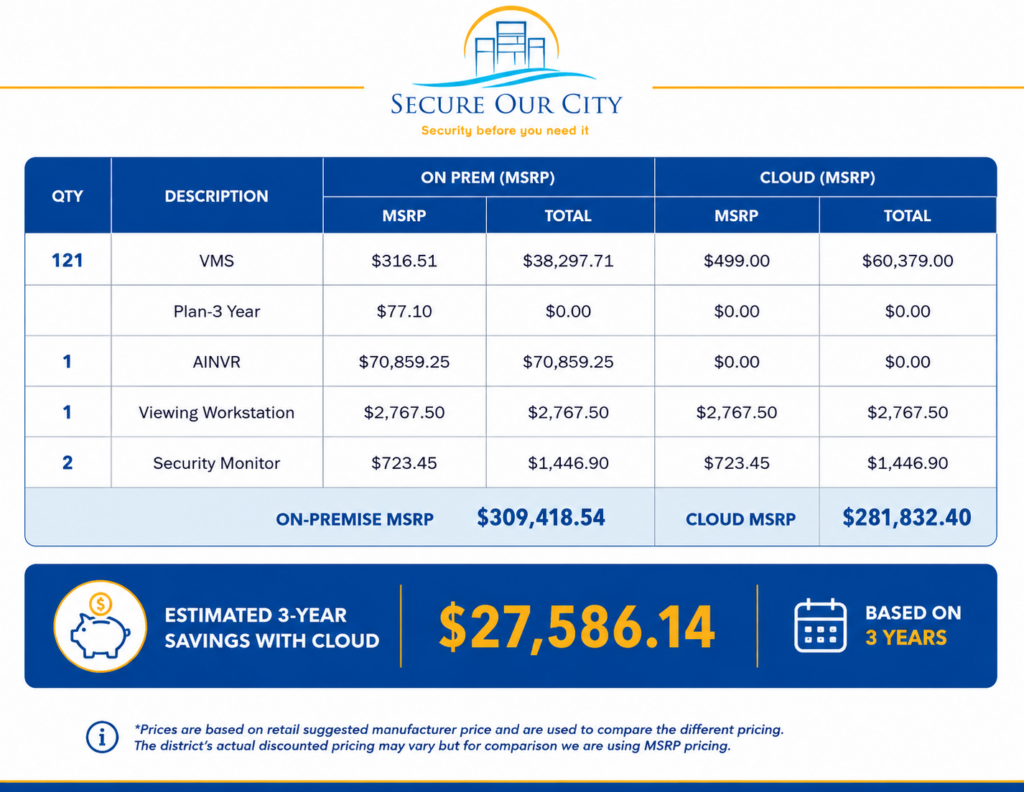
BUDGET based on the actual design for actual School project